
35 Employee Recognition Ideas That Help Morale and Retention
Employee recognition doesn’t have to mean a trophy, a large bonus, or an annual awards banquet. A specific thank-you delivered at the right moment may be exactly right for an everyday contribution. A 20-year career milestone deserves something different.
The goal isn’t to spend the most. It’s to match the recognition to the achievement and the person receiving it.
Good employee recognition ideas include specific thank-you notes, peer shoutouts, recognition from senior leaders, flexible time, development opportunities, team celebrations, milestone gifts, and personalized awards. The best choice depends on the achievement and how the employee prefers to be recognized.
Below are 35 ideas organized by budget and situation, plus the research on what makes recognition land and a simple framework for building a program that stays fair over time.
What Makes Employee Recognition Effective?
Not all recognition works. A generic “great job” in a crowded inbox rarely means much. Gallup and Workhuman point to five qualities that separate the recognition employees remember from the recognition they forget. Their framework describes strategic recognition as fulfilling (the amount makes sense), authentic (it feels genuine), personalized (it fits the individual), equitable (it’s distributed fairly), and embedded in the culture (it happens as part of everyday work, not once a year).
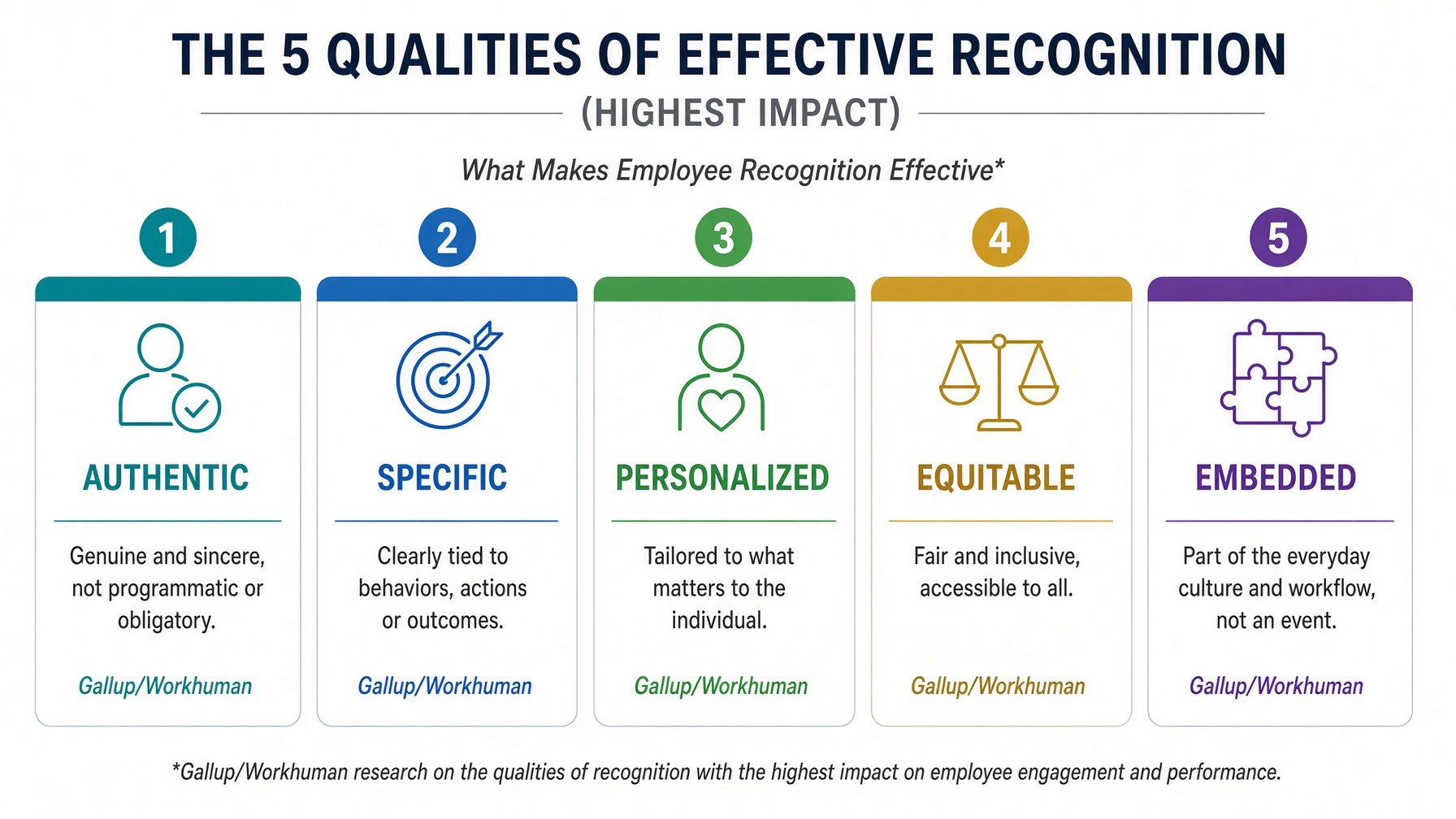
The payoff is real. In Gallup and Workhuman’s research, employees whose recognition satisfied even one of these five qualities were 2.9 times as likely to be engaged as employees whose recognition met none. You don’t have to overhaul everything at once to benefit.
Employee recognition research referenced throughout this guide: Gallup — Employee Retention Depends on Getting Recognition Right .
Make It Authentic
Recognition should identify a real contribution, not fill a slot on a calendar. Employees can tell the difference between a manager who noticed what they did and a manager reading a template. If a recognition moment feels automated or obligatory, it can do more harm than saying nothing at all.
Make It Specific
The most memorable recognition names the action, the result, and the person’s role in it: what happened, why it mattered, and what the employee actually contributed. Compare these two.
Weak: “You’re awesome!”
Strong: “Thank you for taking ownership of the inventory transition. Your work kept the rollout on schedule and prevented fulfillment delays.” The second version tells the employee exactly what to keep doing, which is part of why specific recognition sticks.
Personalize It
One size does not fit all. Don’t assume everyone wants a stage announcement, a gift, cash, a social-media post, or a plaque on the wall. Some people are energized by public praise. Others find it uncomfortable and would rather hear it privately. The only reliable way to know is to ask.
This is where most workplaces fall short. Gallup and Workhuman found that only 10% of employees strongly agreed that someone at work had asked how they prefer to be recognized. That’s a low-cost gap to close. A single question turns a guess into a plan.
Keep It Fair
Recognition should follow criteria people can understand. When the same names always come up, recognition starts to read as favoritism, and it quietly demoralizes everyone left out. The scale of that problem is larger than most managers assume. In Gallup research involving more than 7,500 U.S. employees, only 26% strongly agreed that they received similar recognition to coworkers performing at similar levels.
Watch for the common blind spots: rewarding only sales and frontline wins, overlooking quiet contributors, recognizing managers while ignoring the people they lead, and letting the most visible employees absorb all the credit. Fair recognition means deliberately looking past the obvious candidates.
Recognize Contributions While They Are Fresh
Don’t wait nine months for an annual dinner to acknowledge something important that happened today. Recognition delivered close to the accomplishment carries more weight, because the work is still fresh for everyone involved. Save the annual ceremony for milestones; handle everyday excellence in real time.
Make Recognition Part of the Culture
Recognition shouldn’t live only inside annual reviews, Employee Appreciation Day, and retirement parties. The strongest programs create multiple paths so acknowledgment can come from more than one direction: manager to employee, peer to peer, senior leader to employee, and customer to employee. When recognition is woven into how a team operates, it stops feeling like an event and becomes a norm.
35 Employee Recognition Ideas
The list below is grouped by budget and purpose so you can find the right fit fast. Not every accomplishment calls for merchandise. Some of the most meaningful ideas here cost nothing at all.
Free and Low-Cost Employee Recognition Ideas
1. Write a Specific Thank-You Note
A handwritten or genuinely personal note still lands, precisely because so few managers take the time. Name the specific contribution and why it mattered. Gallup notes that meaningful recognition can be low-cost and as simple as a personal note or thank-you card.
2. Give Recognition From a Direct Manager
An employee’s direct manager is one of the most powerful sources of recognition there is. In Gallup’s research, employees most often recalled their most meaningful recognition coming from their direct manager (28%). Use that. When you recognize someone, explain exactly why the accomplishment mattered rather than offering a general compliment.
3. Ask a Senior Leader to Send a Personal Message
A short, sincere message from someone higher up carries real weight. High-level leaders and CEOs accounted for 24% of employees’ most memorable recognition experiences in Gallup’s research, second only to direct managers. A two-line email from a VP or founder who clearly knows what the person accomplished can be remembered for years.
4. Give a Team-Meeting Shoutout
Calling out a specific win in a team meeting can be motivating, but only when the employee is comfortable with public recognition. For people who enjoy the spotlight it’s a genuine reward; for people who don’t, it’s an ordeal. When in doubt, ask first.
5. Send a Private Recognition Message
For employees who dislike public attention, a private message can mean more than any announcement. A direct message, a quiet word, or a private email lets you recognize the work without putting the person on stage. Make it the default for anyone who’s told you they’d rather not be singled out.
6. Create a Peer-to-Peer Recognition Channel
Set up a dedicated space where coworkers can recognize each other, whether that’s a Slack or Teams channel, an internal recognition platform, or a section of the company intranet. One rule keeps it meaningful: require every recognition to include why the person is being recognized. Peer recognition without a reason turns into empty applause.
7. Recognize Behind-the-Scenes Work
Deliberately look for the contributors whose work is easy to miss: the person who quietly fixed a broken process, kept a project on track, or covered for a teammate. Making a habit of it counters visibility bias and signals that you’re paying attention to more than the loudest wins.
Employee Recognition Ideas With a Small Budget
8. Buy Their Favorite Coffee or Lunch
A small gesture lands harder when it’s personal. Knowing someone’s regular coffee order or favorite lunch spot shows you paid attention. It’s a modest expense that reads as thoughtful rather than transactional.
9. Give a Small Personalized Desk Gift
A personalized keepsake for the desk turns a small gift into something the employee keeps. An engraved paperweight or desk accessory tied to a specific accomplishment can sit on a desk long after a gift card is spent. For team and appreciation gifting, browse engraved corporate gifts.
10. Offer an Extra-Long Lunch
Time is a reward. An unexpected long lunch after a hard push costs almost nothing and tells the employee you noticed the extra effort.
11. Give Flexible Time
Letting someone leave early, adjust their schedule, or start later the next morning is a genuinely valued form of recognition. Flexibility shows up in the retention literature as one element of what keeps people, and used deliberately after a real accomplishment, it signals trust.
12. Give a Micro-Bonus
A small, spot bonus tied directly to a specific accomplishment can reinforce exactly the behavior you want to see more of. The key word is specific. A micro-bonus works because it’s clearly connected to something the person did. It isn’t automatically better than nonfinancial recognition, and it shouldn’t replace the specific, personal acknowledgment that gives it meaning.
13. Let the Employee Choose the Reward
When you’re not sure what someone would value, let them decide. Offer a menu: a gift card, lunch, extra time, a development opportunity, or a personalized gift. Letting the employee choose is personalization at its simplest, and it removes the guesswork.
Recognition Ideas for Exceptional Performance
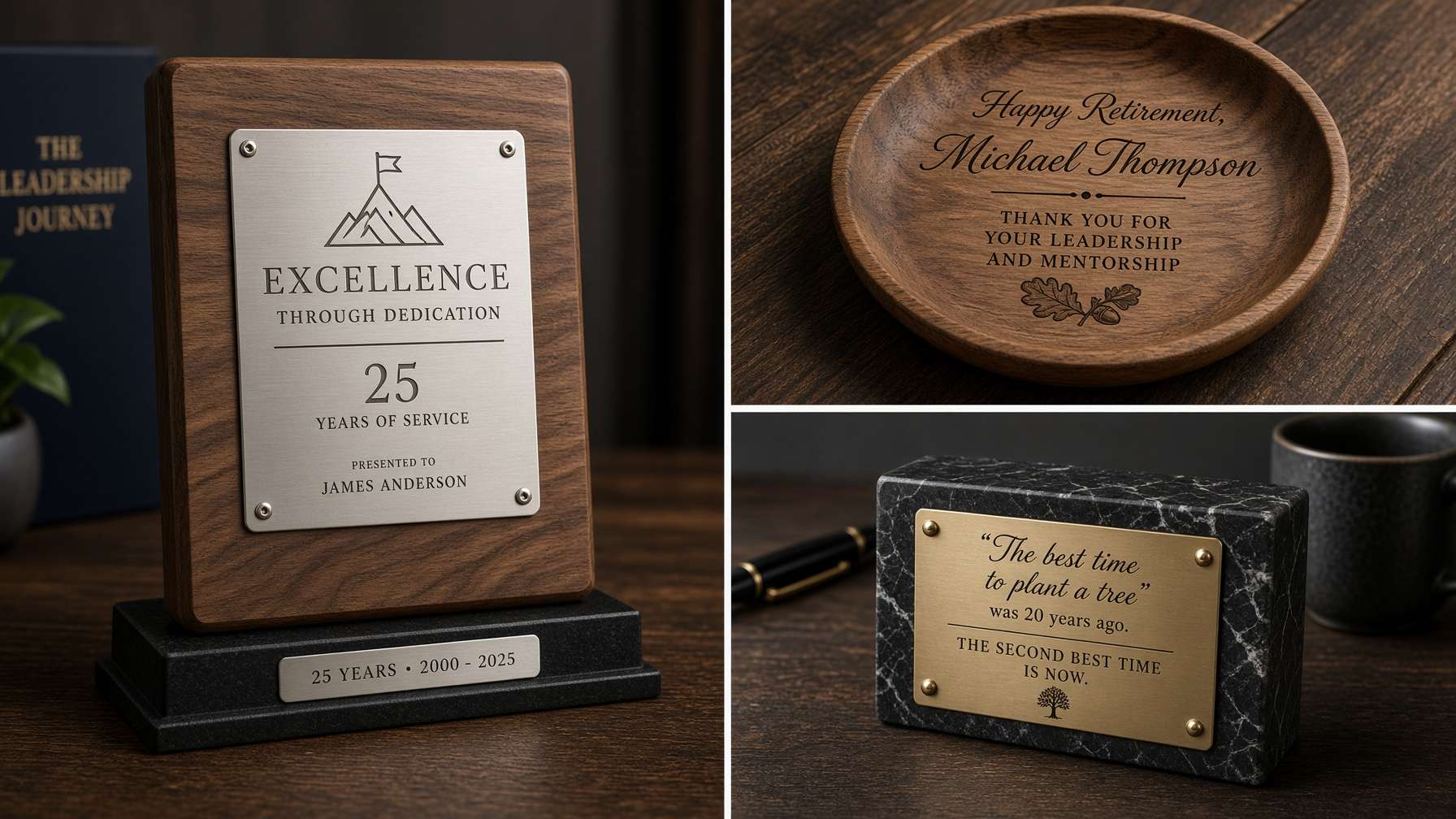
When someone clears a real bar, a passing comment can feel too small for the moment. This is where a permanent, personalized award earns its place: it marks the achievement in a way people can see and keep.
14. Outstanding Achievement Award
For a clearly defined, standout accomplishment, a permanent award marks the moment in a way a passing comment can’t. Reserve it for achievements with real substance so the award keeps its meaning. When the milestone calls for something lasting, explore employee recognition awards that can be engraved with the recipient’s name and the specific accomplishment.
15. Customer Service Award
Recognize a specific customer result rather than generic friendliness. “Resolved a two-week billing dispute and kept a $40k account” is worth far more than “always has a great attitude.”
16. Innovation Award
Acknowledge process improvements, creative problem-solving, new ideas, and better workflows. An innovation award tells the team that finding a smarter way to work is valued, which encourages more of it.
17. Sales Achievement Award
Sales milestones are a natural fit for tangible recognition. Top Producer, Sales Excellence, and Annual Sales Leader awards give measurable achievement a physical marker. Keep the criteria clear.
18. Leadership Recognition
Recognition doesn’t have to be limited to people with management titles. Some of the strongest leaders on a team have no direct reports. Recognize employees who mentor others, carry a difficult project, defuse conflict, or take ownership when something goes wrong. Naming that informal leadership encourages more of it.
Team and Peer Recognition Ideas
19. Team Achievement Award
Some wins belong to a group, and forcing every result into individual competition can undercut the collaboration that produced it. A team achievement award recognizes a shared accomplishment and reinforces that the outcome mattered more than individual credit.
20. Peer-Nominated Recognition
Let employees nominate each other, but give them clear criteria to nominate against. Structure keeps peer recognition credible and prevents it from becoming a popularity contest. A short form asking what the person did and why it mattered is usually enough.
21. Collaboration Award
Recognize successful teamwork across departments, the kind of cooperation that’s easy to overlook because no single team owns it. A collaboration award signals that helping another group succeed is valued.
22. Unsung Hero Recognition
An unsung hero award exists specifically to counter visibility bias. It’s a built-in prompt to look for the person whose steady, quiet work holds things together without drawing attention, so the quiet contributors don’t stay invisible.
23. Customer-Nominated Recognition
When customers praise an employee by name in comments, testimonials, emails, or satisfaction feedback, pass it along, where permission and company policy allow. Recognition from a customer carries a credibility internal praise can’t replicate.
Project and Milestone Recognition
24. Recognize Completion of a Major Project
Don’t wait for Employee of the Month to acknowledge a major project. Recognize the successful launch, the met deadline, the operational fix, or the large customer implementation while it’s fresh. Project-based recognition is meaningful precisely because it’s tied to a concrete, hard-won outcome.
25. Years of Service Award
Service milestones at 5, 10, 15, 20, and 25-plus years mark commitment that’s increasingly rare, and they deserve to be marked in kind. A permanent keepsake gives a long tenure a physical anchor. You can find engraved employee awards suited to service milestones and engraved with the recipient’s name, years of service, and company.
26. Work Anniversary Recognition
Not every anniversary needs a trophy. Smaller work anniversaries can be marked with a personal note from a leader, a team acknowledgment, a lunch, or a modest personalized gift. Scale the gesture so the bigger anniversaries still feel distinct.
27. Promotion Recognition
When you recognize a promotion, focus on what led to it, not just the new title. Naming the work and judgment that earned it tells everyone watching exactly what advancement takes.
28. Retirement Recognition
A career winding down is one of the few moments that clearly calls for something permanent. A personalized keepsake gives decades of contribution a lasting marker the retiree can take with them. For inscription wording and gift ideas suited to the occasion, see our guide to retirement engraving ideas.
Recognition Ideas That Encourage Growth
29. Pay for a Course or Certification
Recognizing strong work by investing in someone’s development sends a dual message: you value what they did, and you’re invested in where they’re going. Covering a course or certification is recognition that pays the employee back in career terms, not just the moment.
30. Offer Conference Attendance
Sending an employee to a relevant conference rewards good work while building skill and network. It’s recognition that doubles as development, often more motivating than a gift card of equal cost.
31. Provide Mentorship
Pairing an employee with a mentor, or formally recognizing someone as a mentor, invests in growth on both sides. Mentorship and coaching consistently show up in retention research as part of what keeps people engaged.
32. Give a Stretch Opportunity
A high-visibility project or a chance to lead something new can be a powerful form of recognition. Use it carefully. The opportunity should feel like growth and trust, not unpaid extra work piled on top of an already full plate. Pair it with support and, where appropriate, acknowledgment of the added responsibility.
Culture-Based Recognition Ideas
33. Company Values Award
Recognize employees who visibly demonstrate a core value like integrity, service, innovation, teamwork, or leadership. The key is to always explain how the person demonstrated the value. A values award without a specific story behind it reduces the value to a slogan.
34. Recognition Wall
A recognition wall, physical or digital, gives acknowledgment a visible home. It can live in an office hallway, on the intranet, or as a Slack or Teams board. Let peers contribute so recognition flows in multiple directions rather than only from the top down.
35. Create a Recognition Time Capsule
For a retirement, a 10, 20, or 25-year anniversary, or another major career milestone, build a recognition time capsule. Quietly ask coworkers to each contribute something: a specific memory, an accomplishment they witnessed, a short thank-you, or something they learned from the person. Collect the messages, then package them alongside a personalized keepsake or personalized employee award engraved with the milestone.
What makes this idea land is the combination. The written memories capture what the person meant to the people around them. The engraved piece gives that sentiment a permanent form. For a milestone that genuinely deserves to be marked, it’s hard to do better than a stack of specific, heartfelt messages paired with something the person can keep.
Employee Recognition Ideas by Budget
Low-cost doesn’t have to mean low-value. Gallup specifically notes that recognition can be meaningful at very little cost when it’s personal and genuine. Use this as a quick reference when you’re matching an idea to what you can spend.
| Budget | Recognition ideas |
|---|---|
| Free | Specific thank-you, peer recognition, leadership note, private praise |
| Under $25 | Coffee, lunch, handwritten card, small personalized gift |
| $25–$100 | Team meal, personalized desk gift, engraved award |
| $100+ | Development opportunity, experience, premium milestone award |
| Flexible | Let the employee choose |
Match the Recognition to the Situation
The right recognition depends less on your budget and more on the moment. Use this table to translate a situation into a fitting response.
| Situation | Good recognition |
|---|---|
| Everyday excellent work | Specific thank-you |
| Quiet contribution | Private manager recognition |
| Major project | Project recognition |
| Team achievement | Shared/team award |
| Sales milestone | Personalized achievement award |
| Customer service | Service recognition |
| Innovation | Innovation award |
| Professional growth | Course/certification |
| 10-year anniversary | Years-of-service award |
| Retirement | Personalized keepsake |
| Remote employee | Mailed gift + personal message |
| Employee dislikes attention | Private recognition |
Public or Private Recognition?
Managers often default to public recognition, assuming a bigger audience makes the moment more meaningful. The data says otherwise. Gallup and Workhuman found that 29% of employees prefer private recognition, 7% prefer public recognition, and 64% prefer a combination of the two.
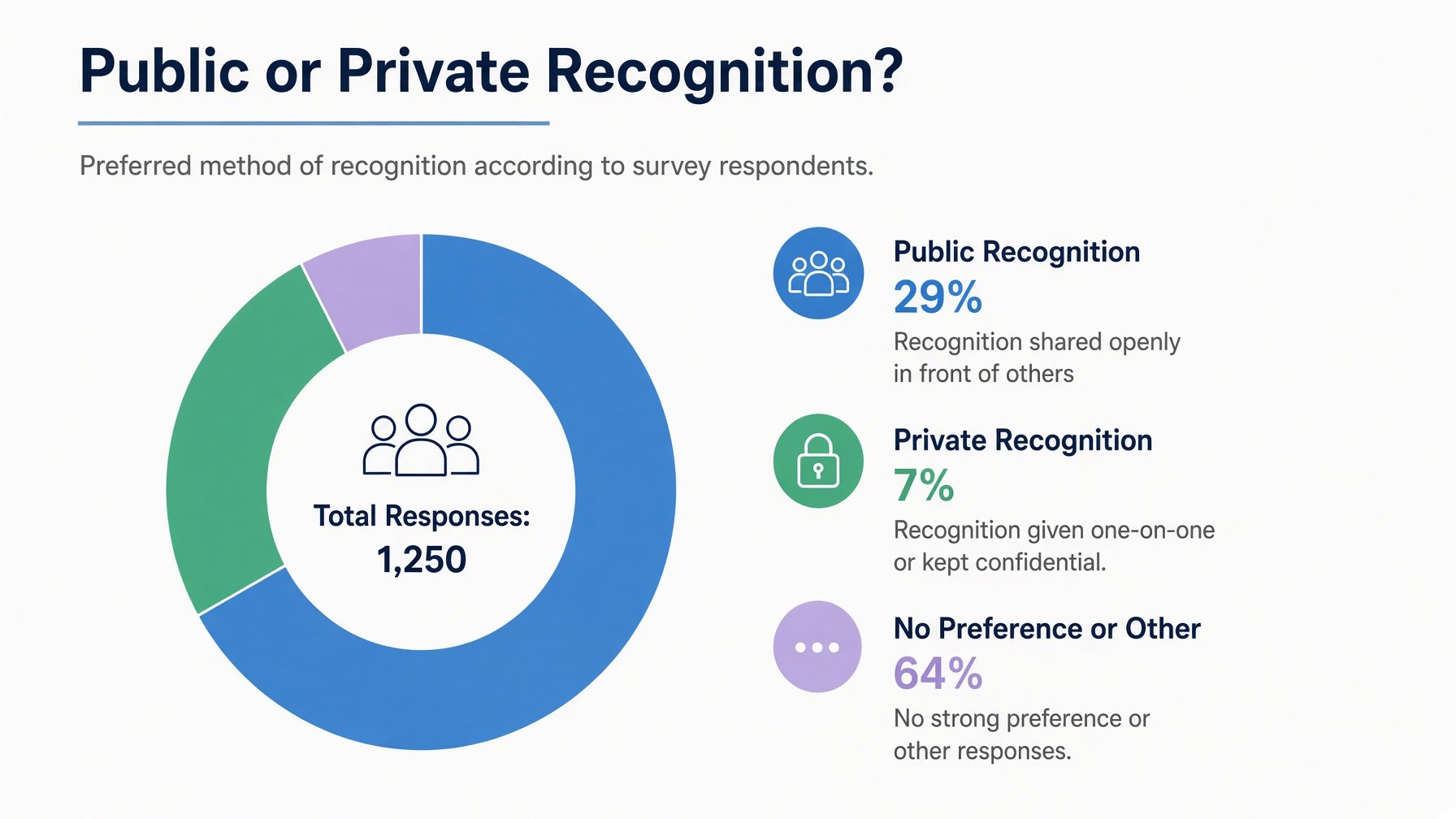
The takeaway is simple: don’t assume public recognition is automatically more meaningful. For most people the answer is a mix, and for nearly a third it’s decidedly private. A recognition program that gives managers both options, and encourages them to ask which the employee prefers, lands far more often than one that treats every win as a stage moment.
How to Build an Employee Recognition Program
A handful of good ideas is a start. A program is what makes recognition consistent, fair, and durable. These eight steps turn scattered good intentions into something that runs on its own.
Step 1: Define the Purpose
Decide what you’re actually recognizing: performance, values, service, leadership, innovation, teamwork, or some combination. A clear purpose keeps the program focused and gives managers a shared understanding of what counts.
Step 2: Ask Employees What They Prefer
Before you choose rewards, ask people how they want to be recognized. Given that only 10% of employees strongly agree anyone has ever asked them this, doing it at all puts you ahead. A short question does the job: “How do you prefer to be recognized when you’ve done something exceptional?”
Step 3: Set Clear Criteria
Make sure anyone can answer the question, “Why did this person receive recognition?” Clear criteria protect the program from drifting into favoritism and make each recognition feel earned rather than arbitrary.
Step 4: Create Multiple Recognition Paths
Build in more than one direction for recognition to flow: from managers, from peers, from senior leaders, and from customers where appropriate. Multiple paths keep recognition from bottlenecking at a single manager’s desk and make it a shared responsibility.
Step 5: Recognize People Promptly
Don’t reserve all recognition for the annual event. Acknowledge meaningful contributions while they’re still fresh, and let the big ceremonies handle the big milestones. Timely recognition is one of the simplest ways to make the whole program feel genuine.
Step 6: Track Participation
Keep an eye on who’s being recognized, who’s doing the recognizing, and which departments are getting overlooked. Recognition audits and simple feedback surface inequity you’d otherwise miss. What you don’t measure, you can’t correct.
Step 7: Review Fairness
Ask the uncomfortable questions on a regular schedule. Are the same people always winning? Are remote employees getting overlooked? Are quiet contributors invisible? Do managers apply consistent criteria? With only 26% of employees strongly agreeing recognition is distributed fairly among comparable performers, this review is worth building in as a habit.
Step 8: Adjust the Program
A recognition program should evolve based on feedback, participation, employee preferences, and shifting company goals. Treat it as something you maintain, not something you launch once and leave alone.
Why Employee Recognition Matters
The case for getting recognition right is straightforward, and it doesn’t require a wall of statistics. Three findings tell the story.
Retention. In a Gallup and Workhuman study that followed 3,447 employees from 2022 to 2024, well-recognized employees were 45% less likely to have changed organizations two years later. That’s a longitudinal association, not a guaranteed lever, but the direction is clear and the sample is real.
Engagement. Employees whose recognition satisfied at least one of Gallup’s five recognition pillars were 2.9 times as likely to be engaged as those whose recognition met none. Even modest improvements to how you recognize people can pay off.
The recognition gap. Only 22% of employees in Gallup’s 2024 study said they receive the right amount of recognition for the work they do. Most people feel under-recognized, which means there’s substantial room to do better without spending much.
Read the Gallup ResearchWhat Recognition Cannot Fix
Recognition matters, but it has limits, and pretending otherwise undermines its credibility. Recognition cannot compensate for poor management, unfair pay, chronic overwork, a lack of advancement, or unhealthy working conditions.
The retention research makes this clear: turnover is multifactorial, shaped by job satisfaction, workload, growth, supervision, compensation, organizational support, and work-life balance alongside recognition. As the 2014 overview puts it, one size does not fit all, and different employees have different reasons for staying or leaving.
Recognition is one part of the employee experience, not a substitute for fair pay, good management, growth opportunities, or healthy working conditions. Sometimes a specific thank-you is enough, and sometimes the milestone deserves something permanent, but neither will hold onto an employee who’s underpaid or poorly managed. Recognition works best on top of a foundation that’s already sound.
Make the Recognition Match the Achievement
A thoughtful thank-you may be right for today’s win. A career milestone deserves something that lasts. When the moment calls for a permanent keepsake, explore personalized employee awards engraved with the recipient’s name, achievement, service date, message, or eligible company logo. For larger recognition efforts, you can also look into custom engraving for company logos and bulk projects.
Ask Us About Custom Employee Recognition Engraving
Planning awards for a team, a service milestone, or a company-wide recognition program? Tell us what you have in mind and our engraving team will help you get the wording, quantities, logo setup, and timeline right. Share as much or as little as you like, and we’ll follow up with options.
Prefer to browse first? See custom engraving options.
Frequently Asked Questions
How do you recognize employees without spending money?
Free recognition is often the most personal. Give specific praise that names the actual contribution, ask a senior leader to send a short note, encourage peer acknowledgment through an internal channel, write a handwritten thank-you, or highlight the work in a company recognition space. What makes these land isn’t the price. It’s the specificity and sincerity behind them.
Should employee recognition be public?
Not always. Gallup and Workhuman found that 29% of employees prefer private recognition, 7% prefer public recognition, and 64% prefer a combination. Public recognition works well for people who enjoy it and can backfire for those who don’t. The safest approach is to ask each person how they’d prefer to be recognized rather than defaulting to a public announcement.
Is employee recognition the same as an employee reward?
No. Recognition is the acknowledgment of what someone did and why it mattered. A reward may accompany that acknowledgment, but recognition can be verbal, written, experiential, developmental, or tangible on its own. A reward without genuine recognition behind it tends to feel hollow.
How often should employees be recognized?
Recognition should happen often enough that meaningful contributions are acknowledged while they’re still fresh, rather than being saved for annual reviews or ceremonies. There’s no rigid schedule that fits every team, but the practical test is simple: if something genuinely good happened, don’t wait months to say so.
What should you write on an employee award?
A strong engraved award generally includes the recipient’s name, the achievement, why it mattered, and the date or company. That combination is what turns a generic plaque into a specific, lasting record of the person’s contribution.